A Necessary Evil: A History of American Distrust of Government by Wills Garry
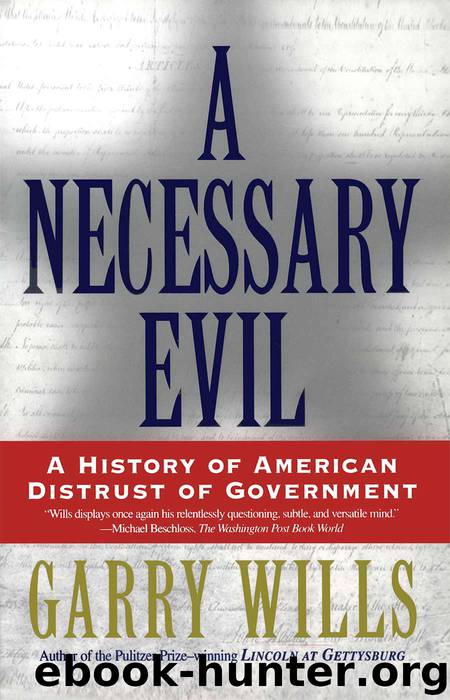
Author:Wills, Garry [Wills, Garry]
Language: eng
Format: epub
Publisher: Simon & Schuster
Published: 2013-05-28T00:00:00+00:00
16.
From Daniel Shays to Timothy McVeigh
Shays’s Rebellion (1786–87)
The rebellion that finally took the name of one of its leaders (Daniel Shays) is now applied to a range of activities in Massachusetts running through the years 1784–87, but it reached its climax when Shays led armed forces against troops rallied by the governor of the state. David Szatmary has divided the rebellion into four stages that could, with only minor adjustments, be applied to some other insurrections in our history. In the Shays example, the stages were these:
1. Political protest and petition (1784–86). In the aftermath of the Revolution, the national Congress set up by the Articles of Confederation tried to liquidate war debts and put credit on a sound footing so that foreigners could trade with the new nation on the basis of agreed currencies and financial obligation. Commercial interests in eastern parts of most states tended to support this policy, though we have seen James Madison castigate them for not doing so. The problem was that the hard money and currency redemption policies hurt subsistence farmers in the western parts of the states. Those areas were also subject to Indian conflict and the menace of western British forts not yet removed by postwar diplomacy. They naturally felt that they were shouldering more than their share of the national burden. Lacking hard cash, they needed loose credit for the planting of their future crops. They favored paper money and sliding monetary values, the bane of men like Madison. They protested their plight to the states’ legislators, who were forced to balance the need for western electoral support against national demands being made on them. The farmers felt they were being treated as expendable and took measures to prevent their being ignored.
2. The Regulation (1786). The farmers of Massachusetts took the name of Regulators, the eighteenth-century word for “vigilantes” (see Chapter 18). In the name of equity, they declared a determination to close down “usurping” debtors’ courts. The choice of what was felt to be a minimizing term for their actions was meant to show that these protesters were not revolutionaries. When militia troops were formed to prevent the court closures, the local troops refused to fire on their own.
3. The clash of armies (January–February 1787). Massachusetts governor James Bowdoin, not trusting his own militia to put down the unrest, appealed to Congress for federal troops. Though the Articles of Confederation gave Congress no power to use federal troops for maintaining a state’s internal stability, the pretense was made that the troops were being raised for Indian control (M 9.277–78). There was a measure of reality in the pretense, since keeping discipline on the frontiers was considered a prerequisite for Indian relations. With the strong support of Madison and Hamilton, the measure for mobilizing troops was passed. But the states were, as usual, remiss in meeting the requisitions for cash to support the troops—only Virginia passed a new tax on tobacco to foot the military expense (M 9.278).
Governor Bowdoin could not wait for the inefficient Congress to get troops to him.
Download
This site does not store any files on its server. We only index and link to content provided by other sites. Please contact the content providers to delete copyright contents if any and email us, we'll remove relevant links or contents immediately.
| Africa | Americas |
| Arctic & Antarctica | Asia |
| Australia & Oceania | Europe |
| Middle East | Russia |
| United States | World |
| Ancient Civilizations | Military |
| Historical Study & Educational Resources |
Cat's cradle by Kurt Vonnegut(15446)
Pimp by Iceberg Slim(14686)
4 3 2 1: A Novel by Paul Auster(12520)
Underground: A Human History of the Worlds Beneath Our Feet by Will Hunt(12149)
The Radium Girls by Kate Moore(12097)
Wiseguy by Nicholas Pileggi(5844)
The Fire Next Time by James Baldwin(5509)
Perfect Rhythm by Jae(5473)
American History Stories, Volume III (Yesterday's Classics) by Pratt Mara L(5340)
Paper Towns by Green John(5248)
Pale Blue Dot by Carl Sagan(5083)
A Higher Loyalty: Truth, Lies, and Leadership by James Comey(5020)
The Doomsday Machine by Daniel Ellsberg(4558)
The Mayflower and the Pilgrims' New World by Nathaniel Philbrick(4543)
Killers of the Flower Moon: The Osage Murders and the Birth of the FBI by David Grann(4490)
The Sympathizer by Viet Thanh Nguyen(4450)
Too Much and Not the Mood by Durga Chew-Bose(4392)
The Borden Murders by Sarah Miller(4389)
Sticky Fingers by Joe Hagan(4257)
